



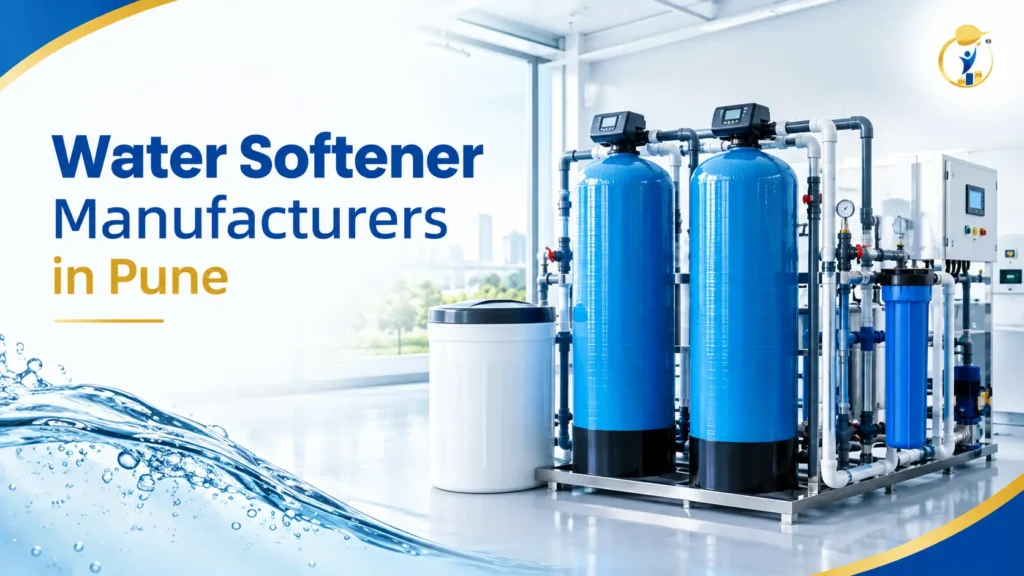
Water Softener Manufacturers in Pune: A Buyer’s Guide for Industry, Hotels and Hospitals
What to Know Before Requesting a Quote
If you are searching for water softener manufacturers in Pune, you are likely dealing with one of these problems:
- White scale on boiler tubes, heat exchangers or cooling circuits
- Geysers, RO membranes or laundry machines failing early
- Borewell water that leaves crust on every tap and tile
All three come from hard water. The cost of choosing the wrong supplier is often higher than the cost of the softener itself. An undersized unit, the wrong resin or a missing service contract can quietly cost a business lakhs in fuel, energy and downtime.
This guide explains how softening works, how to size a system, how to tell a manufacturer from a trader, and what to ask before you pay an advance. It does not rank companies. It gives you criteria to judge any of them.
Quick answer: A good water softener manufacturer or supplier in Pune asks for your water analysis before discussing price. They size the system on hardness load and peak flow, not pipe size. They state the resin and valve brand in writing and offer local service. If a quote arrives without one question about your water, treat it as a warning sign.
New to the topic? Read what problems hard water causes and how to convert hard water to soft water in India first.
Why Hard Water Is a Problem in Pune’s Industrial Belts
Hardness comes mainly from dissolved calcium and magnesium. When hard water is heated, evaporated or concentrated, these minerals form scale, mostly calcium carbonate.
Hardness varies by source. As a general pattern, not a guarantee for any address:
- Municipal supply from river-and-dam sources is often comparatively soft.
- Borewell and tanker water can be much harder and varies from plot to plot. See borewell water softener for home if this is your case.
- Industrial clusters such as Pimpri-Chinchwad, Bhosari, Chakan, Ranjangaon, Talegaon and Hinjewadi may have hard feed water where groundwater is used.
Neighbouring buildings can have very different water, so test your own.
What scale actually costs you
Scale insulates. In boilers, a thin deposit makes metal run hotter and burns more fuel for the same steam. In chillers and cooling towers, it cuts heat transfer and raises energy use. In hotels and hospitals, it clogs showerheads, solenoid valves, dishwashers and steam equipment. In laundries, hardness reacts with detergent and leaves linen stiff.
The damage arrives slowly as higher fuel use, more descaling shutdowns and shorter equipment life, which is why many businesses underestimate it.
Reading your water test report
A supplier can only size a softener properly with real data. Get a lab analysis from an NABL-accredited laboratory:
| Parameter | Why it matters |
|---|---|
| Total hardness (as CaCO₃, mg/L) | Main sizing input |
| Calcium and magnesium hardness | Shows scaling tendency |
| Alkalinity | Affects scale and boiler blowdown |
| TDS | Overall mineral load |
| Iron and manganese | Foul resin and shorten its life |
| Free chlorine | Degrades resin over time |
| Turbidity | Needs pre-filtration or the bed clogs |
| pH | Affects corrosion and scaling |
| Silica | Matters for boilers and some processes |
How hard is “hard”?
A commonly used classification (USGS):
| Hardness (mg/L as CaCO₃) | Category |
|---|---|
| 0–60 | Soft |
| 61–120 | Moderately hard |
| 121–180 | Hard |
| Above 180 | Very hard |
India’s drinking-water standard, IS 10500, sets 200 mg/L total hardness as the acceptable limit and 600 mg/L as the permissible limit where no alternative source exists. That is a drinking-water figure. Boilers typically need feedwater close to zero hardness. One grain per gallon (gpg) is about 17.1 mg/L.
How an Industrial Water Softener Works
Ion exchange in plain terms
- Hard water passes through a bed of strong-acid cation (SAC) resin charged with sodium.
- Calcium and magnesium stick to the resin, and sodium is released.
- Outlet water has almost no hardness, so it cannot form scale.
- When the resin is exhausted, the system regenerates: concentrated brine flushes the hardness to drain and recharges the resin.
Two points often get lost in sales talk:
- A softener does not reduce TDS. It swaps hardness ions for sodium. Lower TDS needs RO, often with a softener ahead of it.
- A softener is not a filter. Turbidity, significant iron and organics need pre-treatment or they foul the resin.
Simplex vs. duplex vs. metered systems
| Type | How it works | Best for |
|---|---|---|
| Simplex (single column) | One tank; supply pauses during regeneration unless storage is used | Small units, intermittent use |
| Duplex (twin alternating) | Two tanks; one serves while the other regenerates or waits | Boilers, hospitals, hotels, 24×7 duty |
| Time-clock valve | Regenerates on a timer | Steady, predictable demand |
| Metered valve | Regenerates after a set treated volume | Variable demand; usually saves salt and water |
For round-the-clock use, a duplex metered system is the usual starting point.
Manufacturers, Industrial Suppliers and Commercial Dealers: What’s the Difference?
These terms are used interchangeably online, but they imply different accountability.
Water softener manufacturers in Pune
A manufacturer designs and builds the system, or fabricates vessels and assembles skids in its own workshop. This matters most when you need custom sizing, special materials or an engineered skid. Look for design drawings, a visible workshop and an in-house service team.
Industrial water softener suppliers in Pune
A supplier sources and often installs systems, sometimes with vessels and components bought from others. Ask which parts are theirs, who commissions the plant and what installation record they can show.
Commercial water softener dealers in Pune
A dealer sells and services branded or assembled units, typically for smaller commercial sites such as clinics, restaurants or small hotels. Check brand authorisation, spare-parts stock and service response time. For an example of how a dealer page presents its scope, see water softener dealers in Pune at LSOMM Aqua.
None of these is automatically better. A good dealer of a well-supported brand can serve a small hotel perfectly well.
A simple test: ask to visit the workshop or an operating installation of similar size. Genuine manufacturers are usually glad to show it.
Where Softeners Are Used: Factories, Hotels, Hospitals and Societies
- Automotive and engineering plants: boilers, parts-washing lines, cooling circuits
- Pharma and food and beverage: pre-treatment ahead of RO, and steam for sterilisation and cooking
- Textile and dyeing: consistent dye and wash quality
- Hotels and serviced apartments: laundry, kitchens, boilers, showers. See water softener for hotels in Pune.
- Hospitals: steam sterilisers, laundry, plumbing protection
- IT parks and towers: chillers, cooling towers, hot-water systems
- Housing societies: shared borewell supply. See water softener for flats in Pune.
Each application differs in tolerance for residual hardness, flow pattern and acceptable downtime. That is why one-size-fits-all quotes are a red flag.
How to Size a Softener Correctly
Pipe diameter does not set the size. Two numbers do:
- Peak flow rate (m³/h): sets vessel diameter and valve size.
- Daily hardness load (kg as CaCO₃/day): sets resin volume and regeneration frequency.
Worked example (illustrative only)
A facility uses 20 m³/day at 300 mg/L total hardness.
- Hardness load = 20,000 L × 300 mg/L = 6,000 g, or 6 kg CaCO₃/day
- Planning value: about 40 g CaCO₃ per litre of resin at moderate salt dosing (the supplier should confirm from the resin datasheet)
- Resin for one day of service: 6,000 ÷ 40 = about 150 litres
- Regenerating every two days would need roughly 300 litres plus margin
- A typical salt dose is around 100 g per litre of resin, so roughly 15 kg per regeneration at 150 litres
These numbers help you judge whether a quote is reasonable. They are not a design. Real capacity depends on resin type, salt dose, flow, temperature and iron or other ions.
Common sizing mistakes
- Sizing on pipe size or pump horsepower
- Ignoring peak flow when everything runs at once
- Skipping pre-treatment for iron, turbidity or chlorine
- Leaving no margin for growth
- Using a time-clock valve where demand varies
What to give the supplier
Lab analysis, daily and peak demand, operating hours, whether supply can pause, required outlet hardness, pressure and temperature, available space, drain and power, and any existing pre-treatment.
What a Good Quote Must Include
Compare specifications, not just price.
| Item | What to look for |
|---|---|
| Resin | Type, brand, litres, expected life |
| Vessel | FRP, rubber-lined mild steel or stainless steel; pressure rating |
| Control valve | Brand, model, metered or timed, manual override |
| Brine tank | Material, capacity, safety float |
| Pre-filtration | Sand, carbon or cartridge if needed |
| Test kit | For routine outlet hardness checks |
| Piping and bypass | Material and arrangement |
| Instrumentation | Gauges, flow meter, sampling points |
| Warranty | Coverage, duration, exclusions |
| Commissioning | Who does it; operator training included? |
| AMC | Scope, visit frequency, response time |
A quote that says only “softener 1000 LPH” plus a price tells you nothing about what you are buying.
Resin, vessels and valves
- Resin decides performance and life. Chlorine, iron and poor care age it faster. Ask for the datasheet and verify the litres delivered.
- Vessels: FRP resists corrosion and suits small to mid-sized systems. Rubber-lined mild steel is common in large plants, so lining quality matters. Stainless steel suits hygiene-critical uses at higher cost.
- Valves control regeneration. Choose a recognised brand with spares and service in Maharashtra.
Salt, water and running costs
- Salt is the main consumable. Use clean softener-grade salt, because poor salt fouls the brine tank and resin.
- Regeneration water varies with rinse volume.
- Power use is small.
- Resin replacement comes after many years, depending on conditions.
- AMC and spares are the recurring service cost.
A correctly sized metered system usually uses less salt and water than a badly sized timed one, so a higher purchase price can pay back.
Environment and health: Regeneration brine is high in salts, so plan the drain and check discharge requirements. Softened water contains more sodium than raw water. People on strict low-sodium diets should ask their doctor, and many sites keep a separate untreated drinking tap.
Softener vs. RO vs. Antiscalant vs. Magnetic Descalers
| Technology | What it does | Limitation |
|---|---|---|
| Ion-exchange softener | Removes hardness ions | Doesn’t lower TDS; needs salt |
| RO | Removes most dissolved salts | Scale damages membranes, so softening or antiscalant is often needed first |
| Antiscalant | Slows scale formation | Manages scale rather than removing hardness; ongoing chemical cost |
| Magnetic or electronic descalers | Marketed as altering scale behaviour | Independent evidence is mixed; not a substitute where strict control is needed |
| Lime-soda softening | Precipitation for large flows | Needs sludge handling |
Installation, Commissioning and Maintenance
Site visit
A reliable supplier visits before quoting and checks the source and storage, pumps and pressure, space, drainage, electrical supply, and where bypass and sampling points go.
Commissioning
Insist on:
- A recorded outlet hardness test
- A demonstration of a full regeneration cycle
- Operator training on salt filling, bypass and settings
- A handover pack with resin quantity, valve settings, drawings and service contacts
Many problems blamed on “bad softeners” come from skipped commissioning or untrained operators.
Maintenance routine
- Daily or per shift: outlet hardness and salt level
- Weekly: brine tank for sludge or salt bridging
- Monthly: valves, leaks, gauges, drain flow
- Periodically: clean brine tank; check resin and pre-filter media
- Annually or under AMC: professional inspection and valve servicing
Warning signs: hardness in the outlet, falling pressure, salt not being used, brine tank overflow, resin beads in the drain.
How to Choose a Supplier in Pune
Questions to ask
- Will you review our water analysis before quoting?
- How did you calculate size and daily hardness load?
- Which resin brand, and how many litres?
- Which valve brand, and are spares stocked in Pune?
- What vessel material and pressure rating?
- Is pre-treatment needed, and why?
- Can we see a working installation of similar size?
- What does the warranty cover and exclude?
- What does the AMC include, and what is the response time?
- Who installs and commissions: your staff or a subcontractor?
- What are the expected salt and water use per regeneration?
- What happens if outlet hardness misses the agreed value?
Red flags
- A price quoted before any water data is requested
- Vague claims like “removes all impurities”
- No resin brand or quantity stated
- Refusal to show an installation or workshop
- Pressure for a large advance before specs are agreed
- No written warranty or service commitment
- Promises that a softener will fix TDS, odour or bacteria
Decision framework by setting
- Define the purpose (boiler, cooling, laundry, RO pre-treatment, plumbing protection).
- Test the water.
- Decide on continuity: duplex or storage if supply cannot stop.
- Shortlist three suppliers and request itemised specs.
- Compare total cost of ownership.
- Visit references and ask about service response.
- Write the acceptance test into the order.
| Setting | Priority | Worth considering |
|---|---|---|
| Boiler plant | Near-zero hardness, continuous supply | Duplex metered softener |
| Cooling tower or chiller | Scale control | Softener plus blowdown strategy |
| Hospital | Reliability, uptime | Duplex system, strong AMC |
| Hotel | Laundry, hot water | Metered system sized for peak demand |
| RO pre-treatment | Membrane protection | Pre-filter plus softener or antiscalant |
| Flat or society | Plumbing protection | Metered unit sized to shared demand |
Frequently Asked Questions
1. What is the difference between a water softener manufacturer and a supplier in Pune?
A manufacturer designs and builds or assembles systems in its own facility. A supplier or dealer may source components or complete units from others. Both can be reliable. Ask who designs, commissions and services the system.
2. How do I know if I need a water softener?
Common signs are white scale on taps and heating elements, poor soap lather, stiff laundry and short geyser or boiler life. The reliable method is a lab test for total hardness.
3. What hardness level is acceptable?
IS 10500 gives 200 mg/L as the acceptable limit and 600 mg/L as the permissible limit for drinking water where no alternative exists. Boilers and many processes need water far closer to zero.
4. Does a water softener reduce TDS?
No. It exchanges calcium and magnesium for sodium, so TDS stays roughly the same. Lowering TDS needs RO or a similar process.
5. Is softened water safe to drink?
Generally yes for most people, but it has extra sodium. Anyone on a sodium-restricted diet should ask their doctor and may prefer a separate untreated drinking tap.
6. How do I size an industrial water softener?
Calculate daily hardness load (flow × hardness) and peak flow. Load sets resin volume and regeneration frequency, and peak flow sets vessel and valve size. Always size from a lab analysis.
7. How often does a softener regenerate?
It depends on resin volume, hardness and usage. Metered systems regenerate by treated volume, which is generally more efficient than a fixed timer.
8. How long does softener resin last?
Many years with good care. Chlorine, iron fouling and poor maintenance shorten its life. Ask for the datasheet and expected life in your conditions.
9. What does an industrial water softener cost in Pune?
Prices vary widely with capacity, vessel material, valve type, automation and pre-treatment. Get itemised quotes and compare specifications and lifetime cost, not only the headline price.
10. Do I need a softener if I already have an RO plant?
Often yes, if the water is hard, because scale damages membranes. Softening or antiscalant dosing ahead of RO is common, depending on the analysis.
11. Are magnetic or electronic descalers a substitute for a softener?
Not where strict hardness control is needed. Evidence is inconsistent and these devices do not remove hardness. For boilers and critical uses, ion exchange is the established approach.
12. What should an AMC for a water softener include?
Scheduled visits, valve and control checks, resin and brine system inspection, outlet hardness testing and a defined breakdown response time. Get the scope in writing.
Conclusion
Choosing among water softener manufacturers, industrial suppliers and commercial dealers in Pune is a technical decision. Start with a proper water analysis. Size on hardness load and peak flow. Compare written specifications for resin, vessels and valves. Prefer suppliers who can show working installations and commit to service.
Next step: Collect a recent lab report, your daily and peak demand and your required outlet hardness. Then contact LSOMM Aqua for a requirement discussion, or see the services page and homepage for what is offered.